What Does “Clean Beauty” Actually Mean?
Why “Clean Beauty” Doesn't Mean What You Think It Means
Have you ever stood in front of a beauty display, picked up a bottle that says “clean” right on the label, and still had no idea what that actually promised you? If so, I want you to know something up front: that confusion isn't your fault.
Here's a fact that surprises almost every client I share it with: there is no legal definition of “clean beauty.” None. No governing body regulates the word. No federal agency enforces it. That means any brand — big or small — can print “clean” on a bottle without meeting a single standardized requirement to back it up.
I've spent years helping women feel confident in their skin and their color choices, and I can tell you the two go hand in hand — you can't build real confidence on top of products you're quietly unsure about. So let's clear up what “clean” should mean, starting with the words that get used as stand-ins for it.
The Buzzwords That Aren't Actually Safety Claims
A few terms show up constantly in beauty marketing, and I want you to be able to spot them for what they are:
- Vegan means no animal-derived ingredients. That's it. A product can be entirely vegan and still contain ingredients that concern me as someone who studies this closely.
- Cruelty-free is a real and important ethical stance against animal testing — but it tells you nothing about what's actually in the bottle.
- “Natural” and botanical packaging are design choices, not disclosures. A leaf on the label is not an ingredient list.
- An essential oil or plant extract in the formula doesn't make the rest of it clean. Sometimes it's even used to draw your eye away from an undisclosed fragrance blend doing the actual scenting.
- “Paraben-free” or “sulfate-free” tells you what one category the brand chose to avoid. It says nothing about everything else still in the jar.
Every one of these creates a false sense of security. And, unfortunately, some of the biggest names in beauty retail have made that worse, not better.
How the Big Retailers Muddied the Waters Further
In recent years, Sephora, Ulta, and Target each rolled out their own “clean” seal programs. I understand the instinct — someone needed to try to bring order to an unregulated space. But each program shares the same critical gap: fragrance.
In the U.S., the word “fragrance” (or “parfum,” or even “natural fragrance”) is legally protected as a trade secret. A brand can list it as a single line on the label while it quietly represents dozens or even hundreds of undisclosed chemical ingredients — and none of the major retailer “clean” seals require full disclosure of what's hiding inside it. Sephora's “Clean at Sephora” program still permits a small amount of synthetic fragrance without requiring disclosure. Target's “Clean at Target” restricts a defined ingredient list but doesn't ban synthetic fragrance either, and sets its own “formulated without” threshold rather than relying on independent verification.
Ulta's “Conscious Beauty” badge is a good example of why self-policing is a real problem: a brand only has to meet one or two of five pillars (clean ingredients, cruelty-free, vegan, sustainable packaging, giving back) to display it. In late 2025, Ulta was named in a class-action lawsuit alleging that some Conscious Beauty products contained ingredients on the program's own prohibited list — a claim still working its way through the courts as I write this, but a telling example of what happens when compliance relies on brands checking their own homework.
None of this means these retailers are acting in bad faith. It means a “clean” seal on a shelf tag is a starting point for your own questions, not a finish line.
So What Should You Actually Look For?
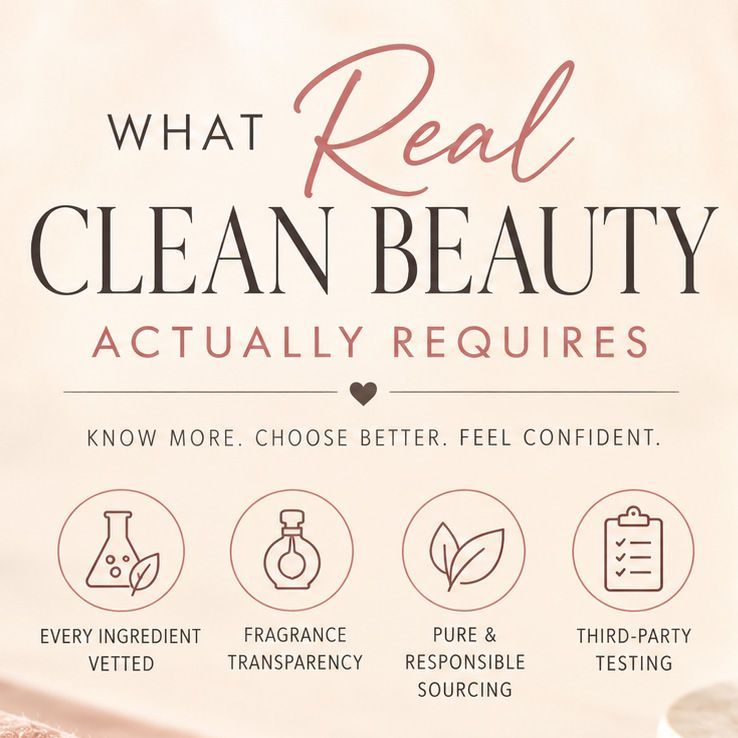
That's the real question, isn't it? Not “what did this brand leave out,” but “what do they actually know about everything they put in, and how do those ingredients behave together?”
That's exactly where I'm headed next month, because it deserves its own conversation. I'll walk you through what genuine ingredient transparency looks like, why fragrance disclosure matters more than almost anything else on a label, and the practical questions you can ask any brand — including the one I represent — to find out if “clean” actually means something or if it's just a word on a bottle.
In the meantime, if you're standing in front of your own bathroom shelf wondering what's really in what you're using, I'd love to help you sort through it. That's a conversation I have with clients all the time, and it's one worth having before you buy your next bottle, not after.