What Real Clean Beauty Actually Requires
What Real Clean Beauty Actually Requires
Last month I told you there's no legal definition of “clean beauty,” and that the retailer seals meant to fix that still leave a fragrance-sized loophole. So here's the question I promised to answer: if a “free of” list and a shelf badge don't get you there, what actually does?
I'll give you the short version first, because I think it matters more than any single ingredient I could name: real clean beauty isn't about what a brand leaves out. It's about whether they can tell you — in detail — what they know about everything they put in.
Every Ingredient Vetted, Not Just Named
Here's something that surprised me when I first learned it: an ingredient name on a label doesn't tell you how that ingredient was actually made. The same listed ingredient can be extracted two completely different ways — one clean, one involving processing solvents that leave contamination risks nobody's required to disclose.
A good example is a category called ethoxylated ingredients, used widely across the beauty industry. The manufacturing process itself can introduce two substances — 1,4-dioxane and ethylene oxide — that are recognized carcinogens. Neither one is required to appear on a label. Neither shows up unless a brand goes looking for it on purpose. That's the difference between a brand that avoids a bad ingredient list and one that actually knows what it's selling you.
Full Transparency, Fragrance Included
I touched on this last month, but it's worth saying plainly: in the U.S., a brand is never required to tell you what's actually inside the word “fragrance.” That one word can legally represent thousands of components. A brand that's serious about clean beauty answers that question before you ever have to ask it — not after.
Investing in Purity, Not Just Avoidance
This is the part that costs a brand real money, which is exactly why so few do it.
Higher-purity colorants. Iron oxide colorants — the pigments behind a lot of makeup shades — can carry naturally occurring heavy metal contamination like lead, arsenic, cadmium, and mercury depending on their purity grade. Choosing the highest-purity option costs more. It also carries less risk.
Verified essential oils. Essential oils get diluted or cut with cheaper synthetic compounds far more often than most people realize. The gold standard for catching that is a lab process called GC-MS testing, which verifies an oil actually matches what it claims to be. Without it, you're taking the label's word for it.
Plant-derived over petroleum-derived, where possible. Along with prioritizing organic and non-GMO ingredients — a standard we talk about constantly in clean food and almost never in beauty, even though the reasoning is the same.
A Simple Checklist You Can Use on Any Brand
Next time you're standing in front of a shelf — mine included — here are the four questions I'd want you to ask:
- Has an independent organization actually verified the product, or is “clean” just the brand's own word?
- If “fragrance” or “parfum” appears on the label, is there any further disclosure of what that means — or is it a closed door?
- Does the brand know and share where its ingredients actually come from, including whether essential oils are purity-tested and ingredients are organic or non-GMO where that's meaningful?
- Is there third-party testing at the ingredient or finished-product level, especially heavy-metal screening on higher-risk raw materials like colorants and clays?
If a brand can't answer those four questions with specifics, “clean” is doing more marketing than it is protecting you.
Why This Is the Standard I Hold Everything To
I didn't learn any of this by accident. Between thirty years of working close to how people present themselves and years now spent helping clients rebuild trust in their skincare after being let down by other brands, I stopped taking “clean” at face value a long time ago. It's the same instinct that drives my color work — I don't want to hand you something that only looks right. I want to know it actually is right, for your skin and your confidence both.
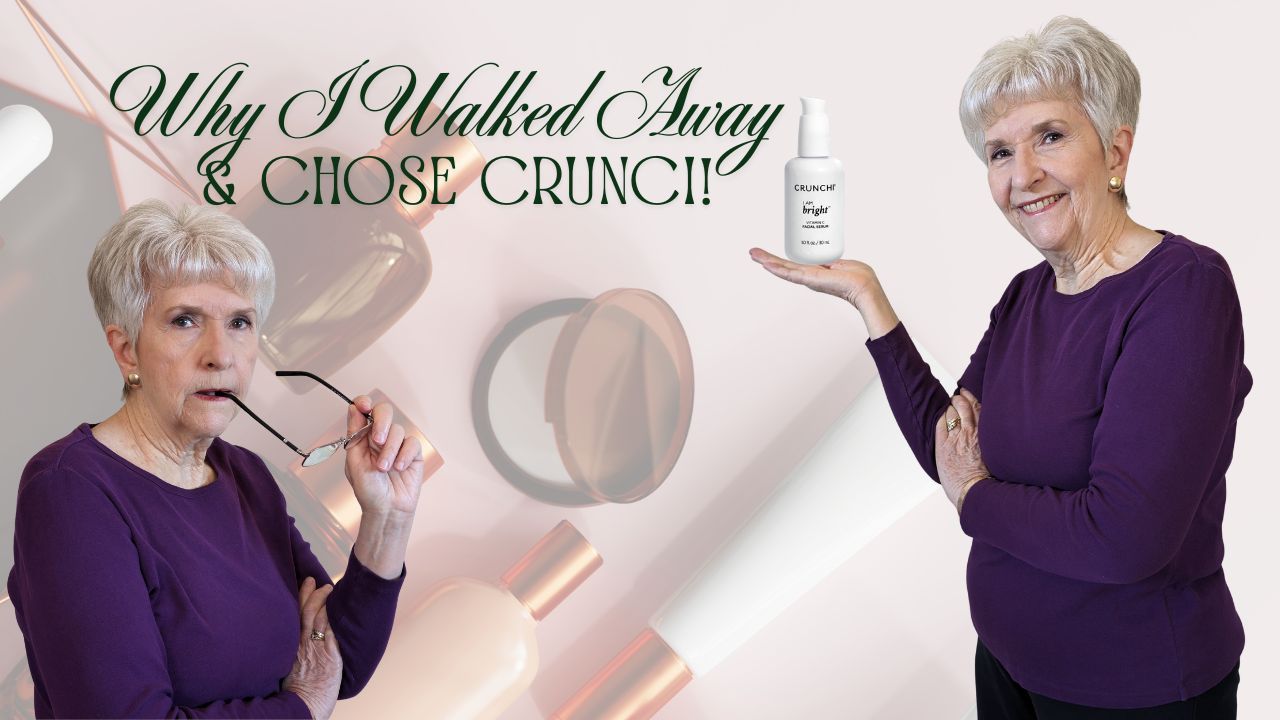
That's the standard I hold the products I recommend to. In fact, I'm waiting right now on a new Crunchi mascara that's been held up for months for exactly this reason — it's still working through EWG Verified testing before Crunchi will release it. I didn't fully understand how big of a process that actually is until I started working this closely with a brand that takes it seriously, and yes, that wait and that testing are part of why the products cost what they cost. If you ever want to talk through what's actually in what you're using — or what's actually in what I recommend — I'm always happy to have that conversation.